
If Powerball Were a Board Game: Its Rules Explained With an Everyday Analogy
Struggling to understand how Powerball works? We break it down by comparing it to a classic board game, step by step and jargon-free.
Powerball has a reputation for being complicated before anyone even tries to explain it: white balls, one red ball, prize tiers... But if you think of it as a classic board game, it all clicks into place a lot faster. Let's build it piece by piece, like reading the instructions from a brand-new box you just opened.
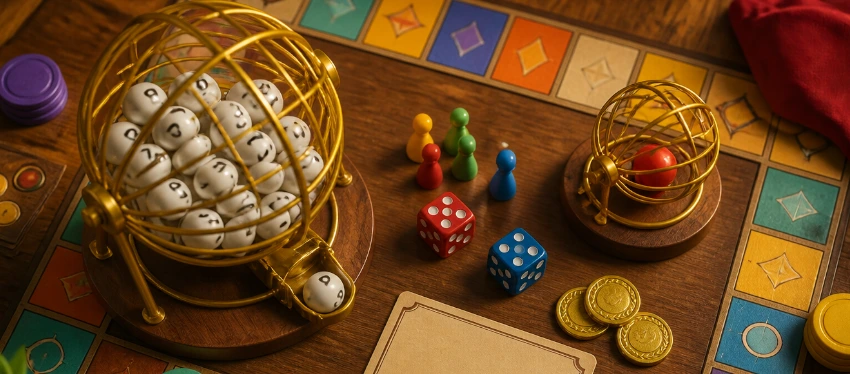
The board: two drums, not one
Picture the game having two separate drums, like two different bags of tokens inside the same box:
- Big drum: 69 numbered white balls.
- Small drum: 26 numbered red balls — the famous "Powerball."
Your mission, just like in any board game with dice and tokens, is to predict what's going to come out of each drum before the box is opened.
Your move: filling in your "bet card"
Before the round starts, each player fills in their own card with:
- 5 numbers from the big drum (1 to 69), no repeats.
- 1 number from the small drum (1 to 26), the red ball.
It's exactly like having to predict, before rolling the dice, five results from a 69-sided die and one result from a separate 26-sided die. Nobody sees your card until the final result is revealed — that's the whole fun of it.
The round: the drums are opened
On draw day (the game's "turns" are Mondays, Wednesdays, and Saturdays), five balls are pulled one by one from the big drum and one from the small drum. That's the result of the round, just like when a board game reveals the card that decides who wins that hand.
How scoring works: you don't need to get everything right
Here's the part that surprises a lot of people: Powerball doesn't have a single winning result — it has a whole scoring table, like games that reward getting "close enough." The more numbers you match from the big drum, and whether you also match the red ball, the higher your prize tier. Matching all five big numbers plus the red ball is the top score — the equivalent of a "full house" — but there's a prize even for matching just the red ball on its own, with no big numbers at all.
In a way, it's like a dartboard with several scoring rings: you don't need to hit dead center to take something home.
Why the top prize is still so hard to win
In a normal board game, the odds of rolling any specific combination with a couple of dice are manageable, because there aren't that many sides in play. Not here: with 69 balls in one drum and 26 in the other, the number of possible combinations is so high that hitting the top score has odds of 1 in 292.2 million. Putting it in the same board-game logic: it would be like needing to roll the exact same dice combination 292 million times in a row — and getting it right on the very first try.
Summing up the rulebook in one sentence
Two drums, one card with six numbers total, a draw three times a week, and a prize table with several tiers of matches. Seen this way, Powerball stops sounding like a math formula and starts sounding like what it actually is: a board game with drums instead of dice.