
The Ball That's Come Up Least Since 1992: Bad Luck or Pure Math?
One number comes up less often than all the others in Powerball. Here's whether that's genuine bad luck or simply how randomness behaves at scale.
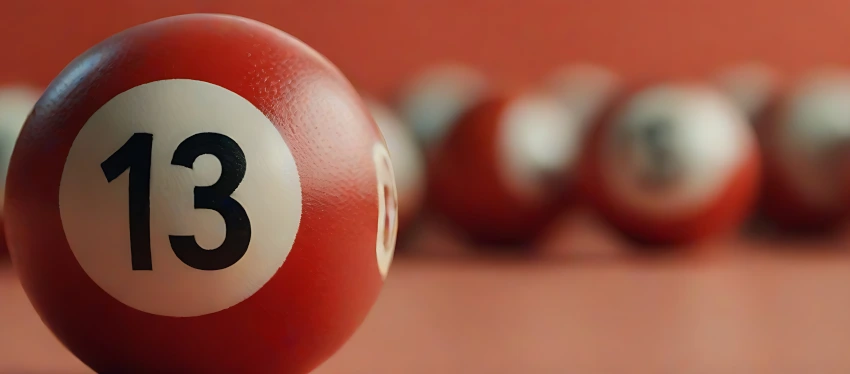
In any lottery with enough history behind it, the same question eventually comes up among the more curious players: if every number has the exact same odds of being drawn, why does one number clearly come up less than the rest? In Powerball, that number exists, and it has a very specific identity: 13.
The data: 13 is the least frequent white ball
Under Powerball's current format — in place since October 2015, with 69 white balls and 26 red balls — the number 13 has turned out to be the one that's appeared least often among the five main balls drawn. In the red-ball drum, the least frequent number has been 15. Neither number is dramatically behind the pack, but both clearly sit at the bottom of the frequency ranking.
Before jumping to any superstitious conclusions, it's worth doing the math.
Why this doesn't mean what it seems to mean
Here's the mental trap a lot of players fall into: if every number has exactly the same chance of coming up in each drawing, then after thousands of drawings, you'd expect them all to appear roughly the same number of times. But "roughly the same number of times" doesn't mean "the exact same number of times," and that distinction is the whole point.
Under the current format, each drawing selects 5 balls from a drum of 69. That means, in any given drawing, each white ball number has a 5-in-69 chance of coming up. Across more than a thousand drawings since 2015, the "expected" number of appearances for any given number lands somewhere around 90-95 times. The most frequent number has come up noticeably above that average, and the least frequent noticeably below it. That gap looks large on paper. Statistically, it isn't.
The real explanation: this is what randomness looks like up close
Flip a coin 1,000 times and you won't get exactly 500 heads and 500 tails — you'll get something close to that, within a margin of variation that's completely normal. With 69 numbers competing to appear in each drawing, that margin of variation becomes even more noticeable, simply because there are far more "slots" for randomness to spread across. A number can sit a bit below average for years without that meaning anything at all about how it'll behave going forward. The drawing has no memory: every time it happens, number 13 has exactly the same odds as number 61, the number that's appeared most often over the same period.
An important caveat: not all of Powerball's history is comparable
There's a detail that often gets glossed over when people talk about "the least frequent number since 1992": Powerball's format has changed several times over its history. It started with a drum of 45 white balls, moved to 49, then to 53, and eventually reached the current 69, with equivalent changes to the red-ball drum along the way. Comparing a number's frequency "since 1992" without accounting for these changes is comparing apples to oranges — a number could only ever come up during the drawings held while it was within the range in use at that time. That's why the most reliable statistics are always limited to the current format's era, from 2015 onward.
So, bad luck or math?
Math, without a doubt. A given number landing at the bottom of the frequency ranking isn't a sign of anything — it's exactly what you'd expect from the normal behavior of randomness at scale. If the same experiment were repeated from scratch, it would probably be an entirely different number sitting in last place, for no hidden reason at all.
In summary
The number 13 has come up less often than the rest under Powerball's current format, but that doesn't make it an "unlucky" number — it's simply the normal variation produced by any random system when you look closely enough. Next time someone says a number "never comes up," the right response isn't to avoid it — it's to remember that the drawing, quite literally, doesn't remember what happened last week.